
“I’m hip.”
“Hip to what?”
“To the whole scene.”
This was the exchange between Kramer and the sniffing accountant, Barry. The scene. What is a scene, after all? In this case, it’s the “bathroom scene”, which is what Kramer says to imply that Barry, the sniffing accountant, is in the bathroom snorting cocaine. The scene. We all know what a scene is. It’s a place, a feeling, a vibe. It’s how something looks when all of the components are pasted together. Less how it looks, maybe, and more how it feels. How it makes you feel. How it makes me feel. We struggle with scenes sometimes. We love certain scenes and dislike other scenes. I went to a concert at the Rave in Milwaukee once. When I left, I walked alone in the rain to my car. I didn’t like that scene, not one bit. The scene on a summer afternoon when the Cubs win and the crowd is singing? Now that’s a scene I like. Elusive, yes, but still quite the scene.
The issue becomes a general lack of understanding about what makes up a scene. A scene feels like it just is. Like it doesn’t need to try to be something, it just is something. And that’s mostly true, but is it really? If I go to Nantucket on a summer Saturday, and I wander around the town and I buy an exceptionally expensive sandwich, which I eat on a bench overlooking a cobbled roadway flanked in hydrangeas, now that’s a scene. But what about me, and my sandwich? Am I in the scene, or am I the scene? This is a question that must be answered, because it’s not a question that is well understood. Is the scene the combination of hydrangeas, bricks, and old timey wooden signs with whales carved into them? Or is the scene the combination of hydrangeas, bricks, old timey wooden signs with whales carved into them AND me sitting on the bench eating my sandwich? It’s the latter.
When in a place, we are not visiting a scene. We are creating the scene. And our presence and behavior and aesthetic is either accretive to the scene or detracting from it. If I’m on the park bench and I’m wearing my dashing Eton linen shirt and white shorts and my well worn loafers, I look like I belong in that place. If I’m eating my sandwich in a manner that suggests I understand how to eat in public, and I’m taking reasonably sized bites and chewing with my mouth closed, then I’m just a guy on a bench enjoying and experiencing and adding to the Nantucket scene. But what if that’s not the case? What if it’s me and the hydrangeas and the bricks and the whale signs but I’m wearing a cut off sleeved T shirt that says in the largest print that could fit “I WONDER IF BEER THINKS ABOUT ME TOO.” And what if I’m eating my sandwich in a hurry and the oil is dripping on my demin shorts and I’m wiping my face, but not fast enough, and I drop the napkins on the ground when I’m finished with them and I burp loudly between bites of my rapidly disappearing sandwich? What then? Am I just visiting the scene and is the scene intact, or am I part of the scene and is the scene diminished because of my presence? I know the answer to the questions, I’m just asking because it seems that not everyone does.
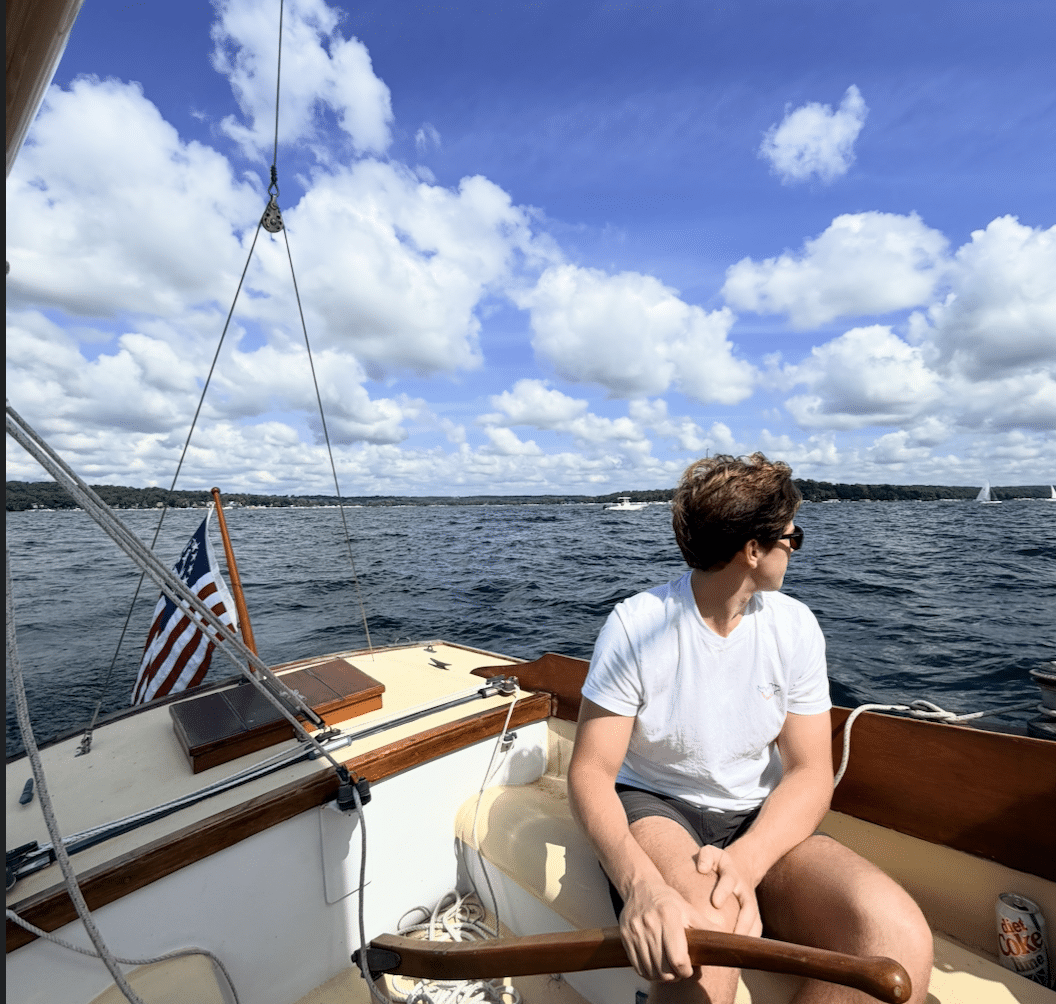
In this example, it seems obvious and we, being of sound mind and mature perspectives, would agree. But now let’s apply this to our scene. To this lake. To the soft waves of summertime and the evenings when the sun sinks low over Fontana and the lake quiets and the cicadas sing and the flags wave and the deep green shoreline with manicured lawns and a couple strolls down the path towards a lakeside dinner at their friend’s house. That’s a scene, man. A wood boat cruises by with no particular place to go and no particular time to be there. A steam boat chugs through the sunset with a small group, raising a toast to the day to the accomplishment and to this life. Now that’s a scene, man. That’s our scene. That’s Lake Geneva in the way I know and love. Now what if that scene is broken by a boat with a surfer behind it, blasting music across the lake that echoes and cuts through the still and the class and calm? Is that boat out enjoying the scene or is it disrupting and clashing with the scene?
IT’S A FREE COUNTRY! The loud boats, the fast boats, and the loud music crowd screams. And they’re right, of course. But within a free country we have a choice, indeed. Do we add to a scene or do we detract from it? Is our presence just in the scene, or does our presence make the scene. Do we visit a place or are we part of a place? If I drive through town racing from stop sign to stop sign, revving my engine at each pause, am I making anyone feel like this place where I am is nice? Or am I creating a diversion of obnoxiousness that, if copied by others, ruins a scene that would otherwise be ideal? It’s all obvious, but perhaps this reminder is needed. If we all respect the scene, let’s make it a point to add to it. Walk the shore path with class. Drive the speed limit. Buy the classic boat. Drive it slow at sunset. Plant the hydrangeas. Raise the flag. Turn the music down. Let’s create the place we want, because the scene isn’t just a place we visit. It’s a place we create.
David,
Always enjoy reading your blog, and I enjoyed your column The Scene. I guess it’s always a matter of opinion and what kind of “scene” people want to create. And not everyone agrees what is a desirable or appropriate scene.
My wife and I are older and we definitely enjoy and appreciate a quiet or moderately low volume scene. That’s why we generally only visit during the week and avoid the weekends, which during summer could be overrun with boats and many of them not so quiet. There’s some element of risk in anything in life, but we have wondered what it would be like if someone bought a beautiful $5 million home on the lake, but the water in front of them was constantly being overrun with loud boats and loud music. It seems like that would detract quite a bit from the lake experience. But of course we run into this stuff all the time on land as well. Loud trucks, cars and motorcycles – all designed or retrofitted to be loud and annoying.